
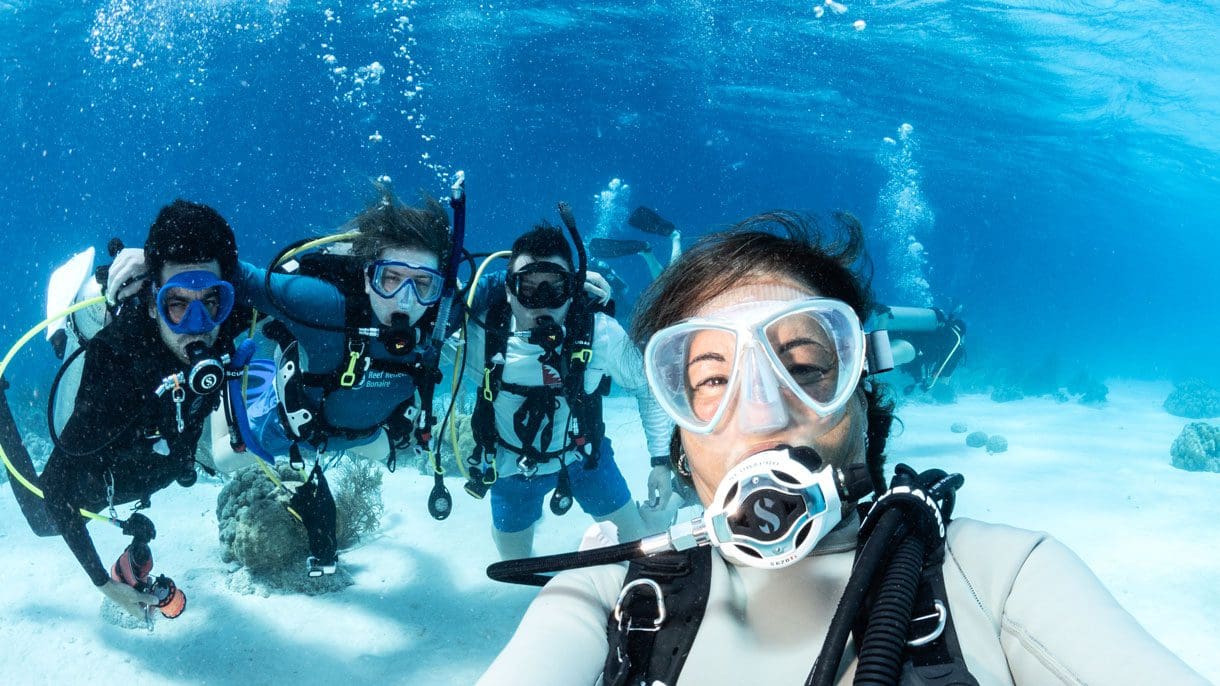
Advice on dive careers certifications and Volunteer Opportunities for Young Ocean Lovers
By Margo Peyton
Every year, I speak at trade shows, on trips, and at school Career Days with bright, energetic young adults graduating from high school who feel that irresistible pull toward the sea. They love the ocean, crave adventure, and dream of a life filled with travel, discovery, and meaningful experiences, rather than staring out an office window from 9 to 5, doing the same thing day after day. This spring, Bella—a high school senior who is already a certified Rescue Diver—called me about volunteer opportunities to become a PADI Divemaster. Like so many others I’ve mentored, she loves travel, meeting fascinating people from all walks of life, and exploring the underwater world. But she was still unsure exactly how to turn that deep passion into a real, sustainable career or if it was even a possibility.
How was I going to pay bills?
Her parents, like so many well-meaning families, expressed the same concern I hear over and over: “Marine biology sounds amazing, but is that really a job that’s going to pay the bills? You won’t be able to make a living on that.” It’s a valid worry. Traditional marine biology roles often require advanced degrees and can start at around $47,000 per year in the U.S., with highly competitive entry-level positions. Yet the wonderful truth I shared with Bella—and want to share with every young person reading this—is that a marine-oriented career path is far broader, more accessible, and more rewarding than most families realize. Diving instruction, ecotourism, marine education, conservation guiding, family adventure travel programs, international dive operations, underwater photography, and many related fields offer genuinely fulfilling ways to live your passion while building a sustainable livelihood.
I told Bella my own story because I was exactly like her at her age. I loved the ocean, animals, travel, chocolate, ice cream, horses, airplanes, fast driving cars and music.
No clear roadmap for my future
My passions were scattered in every direction, and I had no clear roadmap. What I discovered—and what I hope every young ocean lover hears—is that the path to a fulfilling career doesn’t have to be a straight line. It is built one step at a time by trying new things, volunteering, staying open to unexpected opportunities, and relentlessly following what lights you up inside. My journey began with a simple volunteer position at the Provincetown Sea Aquarium. I walked in and asked the owner, Jackie Gleason, if I could volunteer for the summer. She said yes. That one decision opened my eyes and my heart to so many possibilities. I cleaned penguin tanks, fed two rescued wolves, cared for injured harbor seals and sea lions recovering from shark bites or propeller strikes, worked the ticket booth, learned customer service, and taught children about local marine life in the tidal pool area. I absorbed lessons in geography, marine science, animal care, and the pure joy of sharing the ocean with kids. It was messy, hands-on, and unforgettable.
My curiosity led me
I followed my curiosity wherever it led. I became the “cotton candy girl” at the local Penny Patch candy store because I loved chocolate fudge and wanted to learn how to make cotton candy. The job wasn’t résumé gold, but it taught me how to connect with the public, make people smile, and spark excitement in children who watched me whip up cotton candy sticks the way I once watched the girl twist saltwater taffy. I worked two jobs, night and day, in fine jewelry stores, Thunder Road & Galadriel’s Mirror, learned about and sold Lalique crystal and rare gems, and I became a top salesperson at both. Those experiences helped me master the art of sales and customer service. I was able to buy my first car, so I could then travel for school and work.
Tourism and Psychology degrees
I studied travel and tourism and Psychology in college. I use parts of those degrees in my work today. College mostly gave me precious time to mature, make lifelong friends, build character, learn geography, and even pick up skiing. After graduating from college, I worked as a travel agent, quickly becoming the most productive ticketing agent at Timbuktu Travel—a role that inspired my interest in Africa and Australia.
Journey of Tourism
In The Fall and winter of 1986-1987, Qantas Airlines, the oldest airline still in existence today in Australia, offered a contest to Travel Agents selling tickets for the America’s Cup races, being held in Australia.I booked a record number of tickets on Qantas Airlines for the event. The American challenger Stars & Stripes (skippered by Dennis Conner) defeated the Australian defender Kookaburra III (skippered by Iain Murray). I earned free round-trip tickets to Australia and used them to attend the 1988 World Expo. Out of that came opportunities to skydive, hang-glide, learn to surf, and camel-trek. I met incredible adventurers, built character and courage, and discovered that endless possibilities exist if you just work hard and stay focused.
Relationships matter
managed a Travel Network agency office on Cape Cod and built client relationships that remain strong friendships to this day. Then I took the leap on a FAM Trip to the Cayman Islands and decided to stay. I started by working at a Home Depot as a Point-of-Sale Supervisor to earn my work permit in my first foreign country. It was incredibly hard. I cried some days as an “expat” outsider who wasn’t immediately trusted by the local Caymanian staff. But I worked diligently, respected their culture, and eventually earned their friendship and trust. That single lesson in cultural humility and perseverance became foundational to every international success that followed. Once I received my permit, I opened an international travel agency there and truly began expanding my career in ways I had never imagined.
Nothing stopped me
While living in Grand Cayman, I got married, and my son Robbie was born there. We later moved back to the United States, where my daughter Jen was born in Florida. Life changed dramatically when my then-husband left us. As a determined single mother, I created Kids Sea Camp Inc. out of pure passion and necessity. I wanted to spend real, quality time with my children and share the underwater world I loved so much. That decision turned family diving into my life’s work. What started as a way to keep my kids close grew into a very successful family adventure travel company that has now been running strong for more than 26 years.
Tom Peyton enters my life
Continuing on that same joyful path, I never stopped following what brought me happiness. In 2005, through a connection with the Hollywood, Florida Tourism Board, I met my now-husband of 20 years, Tom Peyton, at the Chocolate Mouse Coffee House during an open-mic night. Music, coffee, and chocolate—three of my all-time favorite things—led me straight to him. Together, we run amazing family adventures around the world and recently launched our newest venture, Empty Nester Travelers—traveling the globe, connecting the dots of opportunity, friendships, and shared interests while celebrating the next chapter of life after the kids have grown.
Following my passions worked
The common thread through every single chapter of my life? Adventure, travel, learning from every person and every job, and doing what genuinely made me happy—even when it didn’t look like traditional “career building” on paper. My grandmother, Priscilla Salvador, still echoes in my mind: “Margo, what doesn’t kill you will make you stronger.” I stayed strong, followed my passions, worked hard, stayed true to my moral compass, and remained respectful of all people along the way.
The Careers That Grew from One Passion-Filled Journey
When I talked with Bella, I pointed out how many different professional skills and careers had grown naturally from that same love of the ocean and travel she feels today. My non-linear path gave me real-world proficiency in family dynamics and creating meaningful experiences for parents and children, international contracts and negotiations, dive safety and training standards, travel expertise and consulting, ocean advocacy, dive operation consulting for kids programs, underwater photography, event planning, airline representation, travel writing, and so many more areas. None of these were planned from the beginning. They emerged organically because I kept saying “yes” to opportunities that aligned with what I loved.
Practical Steps for Young Ocean Lovers Like Bella
If you’re a high school senior or recent graduate who dreams of a life connected to the marine world without the 9-to-5 grind, here’s exactly what I shared with Bella—and what has worked for so many others:
- Start with volunteering and entry-level experiences to get your foot in the door with some of the highly sought after jobs.
- Try short-term jobs and side gigs in marine tourism, aquariums, or dive shops to help you find your passion and gain experience.
- Build certifications and hands-on experience with becoming a PADI Jr. Dive master age 15-17 or PADI Divemaster age 18+ (more on Divemaster below).
- Combine your passions creatively, start early so you can do what you love and love what you do.
- Network relentlessly and stay open, maintain relationships, build contacts and stay in touch.
- Address the money question head-on—many marine careers pay well once you gain experience and build a reputation. That includes Kids Sea Camp, we provide Divemaster and instructor courses, internships and hire.
Underwater Photography as a Marine-Oriented Career Path
Underwater photography is one of the most rewarding ways to combine a passion for the ocean, adventure, travel, and creativity into a real career. It’s especially appealing for young adults like Bella who are already Rescue Divers. As someone who has built a 26+ year career around family diving, I’ve seen underwater photography open incredible doors: from documenting Kids Sea Camp trips to creating content for travel writing, event promotion, and ocean advocacy. For me its been a growing passion and all started with my PADI photo specialty and a Sealife Camera and grew to a professional with Olympus and Nauticam. Learning from other divers, taking courses and following my passion. Check out our Photo Gallery
Getting Started: Master diving first, Get certified, and gain your PADI PPB certification as Buoyancy is key when it comes to underwater photography. Nitrox for longer diving capability, Advanced open water for more experience and confidence as a diver. You can build your way up to PADI (Divemaster), a PADI pro level for more value as a hire, then take a PADI Digital Underwater Photographer course. Practice on land before buying expensive gear.
Main Career Paths:
- Liveaboard/Resort Photographer
- Freelance/Stock & Editorial (magazines, National Geographic, NGOs)
- Dive Industry Hybrid (instructor + photographer)
- Commercial/Film & TV
- Scientific/Conservation
- Workshop Leader/Educator
- Niche specialties (family diving, wrecks, macro)
- Magazine, travel writer
- Social media
- Dive Travel Blogger
- Educator and teacher of photography
- Photo equipment specialist and critic
- Underwater weddings
- Documentary
Most successful pros use a hybrid model. Entry-level pay is modest but the lifestyle—daily diving in beautiful places—is exactly what many young ocean lovers crave. With experience, many earn $80k–$150k+.
PADI Divemaster Certification: Your First Step into a Professional Scuba Career
PADI Divemaster is the first professional-level certification in the PADI system and the most popular pro credential worldwide. It turns passionate recreational divers into leaders who can guide dives, assist instructors, and begin building a career in the dive industry.
Prerequisites (as of 2026):
- Age 18+
- Advanced Open Water + Rescue Diver
- 40 logged dives to start (60 to certify)
- Current EFR/CPR
- Medical clearance
Course Includes: Knowledge development, water skills & stamina tests, 24 dive skills at demonstration quality, and practical leadership applications. Duration: 2–8 weeks depending on format. With Kids Sea Camp $900. Others, Cost: $900–$3,500 (cheaper in Southeast Asia or with internships).
Once certified, you can lead dives, assist instructors, teach Discover Scuba Diving, and work at dive centers, resorts, and liveaboards worldwide. It’s the required stepping stone to Assistant Instructor and Open Water Scuba Instructor.
Marine Conservation Volunteer Programs: A Perfect Launchpad
These programs let you dive almost every day, contribute real science, gain professional skills, and explore stunning destinations. Many are designed for recent grads and lead directly to Divemaster training or paid roles.
Top Scuba-Focused Programs
- Bonaire Reef Renewal Foundation (RRFB) – Bonaire, Dutch Caribbean – www.reefrenewalbonaire.org – Coral nurseries, outplanting, and restoration dives. Email volunteering@reefrenewalbonaire.org. Rescue Diver level is a huge plus.
- International SeaKeepers Society – Multiple locations – www.seakeepers.org
- Dive Against Debris cleanups and community events.
Shark Conservation & Advocacy
- PangeaSeed Foundation – pangeaseed.org – Art, science, and shark protection projects.
- Shark Angels – sharkangels.org/volunteer – Mentorship, writing, photography, advocacy, and outreach.
Domestic & Education Opportunities
- Ocean Institute – Dana Point, California – oceaninstitute.org/volunteer-opportunities – Tidepool interpretation and marine education.
Scholarships & Funding
- Women Divers Hall of Fame (WDHOF) – www.wdhof.org/scholarships
20+ categories of scholarships and training grants (including dive training and marine conservation). 2027 applications open September 1–October 31, 2026.
How to Get Started
Match your level, check budgets, and reach out directly. A summer in one of these programs can give you logged dives, credentials, experience, and references that open doors everywhere.
Life is short. Follow your passion. Try new things. Volunteer for jobs simply to see what they feel like. Some experiences won’t go on your résumé, but they build character, confidence, and unexpected connections that can change your life. Stay safe, keep your moral compass pointed true, and trust that the dots will eventually connect.
Bella left our conversation excited about possibilities she hadn’t even considered before. If you’re reading this and feeling that same magnetic pull toward the ocean, know that you don’t need all the answers right now. You only need the courage to take that first step—just like I did when I nervously walked into the Provincetown Sea Aquarium as a teenager.
The underwater world desperately needs passionate, respectful, adventurous people who are willing to show up, work hard, and share their joy. Your journey can start this summer. Dive in.
Attend Scuba Diving Trade shows! They are the best to meet the people in your career path. Talk to your local dive shop and contact me.
If you want to talk more about this or another marine career, give me a shout
Margo Peyton