Why Peak Performance Buoyancy Is the Most Important Skill You’ll Ever Learn Underwater

Perfect dive trip, Palau, Kids Sea Camp

By Robert Peyton, PADI Staff Instructor — Kids Sea Camp

Ask any experienced diver what separates a good diver from a great one, and the answer is almost always the same: buoyancy. Not the gear they’re wearing. Not how many dives are in their logbook. Not even where in the world they’ve been. It comes down to buoyancy — specifically, perfect buoyancy. And that’s exactly what PADI’s Peak Performance Buoyancy (PPB) specialty is designed to teach.

I’ve had the privilege of teaching diving to hundreds of students over the years, from wide-eyed kids taking their first breaths underwater to seasoned adults looking to sharpen skills they thought they already had. And without fail, PPB is the course that produces the most dramatic transformation — often in a single session.

Here’s why I think every diver, at every level, should make PPB a priority.

What Is Peak Performance Buoyancy?

Before we get into the why, let’s quickly cover the what. Buoyancy control is your ability to hover effortlessly in the water — not sinking, not floating up, just suspended. The PADI Peak Performance Buoyancy course takes that fundamental skill and refines it. You’ll learn to fine-tune your weighting so you’re not carrying too much or too little lead, how to use your breath as a buoyancy tool, and how to maintain a streamlined position that puts the least drag on your body as you move through the water.

It sounds simple. It is not — at first. But once it clicks, everything about diving changes.

The Diver Who Destroys the Reef Without Knowing It

Let me paint a picture. You’re diving a beautiful coral wall. The colors are stunning, the fish are everywhere, and you’re excited. You kick a little too hard, drift a little too low, and — crunch. A branch of coral that took 20 years to grow is gone in a second.

It happens constantly, and most divers who do it don’t even realize it. Poor buoyancy is one of the leading causes of accidental reef damage around the world. When divers are overweighted, they tend to fin furiously to stay off the bottom, kicking up sediment, disturbing marine life, and crashing into corals. When they’re underweighted, they fight to stay down, constantly disrupting the water column around them.

PPB fixes this. A diver with peak buoyancy control barely disturbs the water. They glide. They hover. They observe. They’re not fighting the ocean — they’re with it. The environmental impact of a well-trained diver versus a poorly buoyant one is genuinely night and day.

Air Consumption: Your Underwater Fuel Economy

Here’s something most new divers don’t immediately connect: buoyancy and air consumption are deeply linked.

When you’re fighting to maintain depth — constantly finning up, inflating your BCD, then overinflating, then dumping air, then sinking again — your body is working hard. Hard work means faster breathing. Faster breathing means you burn through your tank quickly and the dive ends sooner.

A diver who has mastered PPB uses far less energy. They breathe slowly and deliberately, and those breaths serve double duty — controlling both oxygen intake and buoyancy simultaneously. I’ve seen students go from 45-minute dives to 70-minute dives on the same tank size after completing PPB. That’s not an exaggeration. More time underwater means more of everything you came to see.

Safety First — Always

Beyond the environmental and experiential benefits, buoyancy is a genuine safety issue. Uncontrolled ascents — caused by a diver becoming too positively buoyant and rocketing toward the surface — are one of the most serious risks in recreational diving. Ascending too fast doesn’t allow nitrogen to safely leave your body, which can lead to decompression sickness. In severe cases, this is life-altering or fatal.

PPB teaches divers to stay in control at all times, to recognize when they’re beginning to ascend unintentionally, and to respond with calm, deliberate corrections rather than panic. That calm is everything. Underwater, panic leads to bad decisions. Solid buoyancy skills are one of the best defenses against panic, because you’re not constantly fighting your environment — you feel at home in it.

Why It Matters Even More for Kids

At Kids Sea Camp, buoyancy is something we talk about constantly. Kids are natural movers — they want to touch things, dart around, and explore. Teaching them PPB early gives them the discipline to channel that energy without causing harm to themselves or the reef.

Kids who learn proper buoyancy from the start build habits that stay with them for life. They become the adults who don’t drag their gauges across the coral, who help protect dive sites rather than degrade them. In a sport where we’re asking the ocean to share its beauty with us, that stewardship matters enormously.

For parents diving alongside their children, PPB helps them stay at the same depth, move at the same pace, and share the experience together. There’s something really special about watching a parent and child hover side by side over a coral garden, completely still, watching a sea turtle sleep.

Underwater Photography: You Can't Shoot What You Can't Hover For

If you’ve ever tried to photograph a nudibranch, a seahorse, or a shy pufferfish, you already know the frustration: the moment you get close, you drift, you fin to correct, and the subject is gone — or worse, you’ve spooked it entirely. Underwater photography is one of the fastest-growing parts of recreational diving, and buoyancy is the invisible foundation beneath every great shot. A photographer who can hold a perfect hover — motionless, at the exact right depth, without touching anything — can take their time, frame the shot, adjust the lighting, and wait for the animal to relax. A photographer who is fighting their buoyancy is always rushing, always compensating, and the images show it. Beyond the creative benefits, good buoyancy also protects the subjects you’re trying to capture. Getting close to a coral-encrusted wall for a macro shot with poor buoyancy control means fins churning up sediment, hands reaching out for balance, and delicate organisms getting disturbed or crushed. PPB teaches you to be still, and stillness is the single most valuable skill an underwater photographer can have.

For the Experienced Diver: You're Not Too Advanced for This

I’ve met 200-dive divers who are still overweighted by six pounds and don’t know it. Log count is not the same as skill level. Habits get ingrained, and not all of them are good ones.

PPB is not just a beginner course — it’s a tune-up that benefits everyone. Many instructors and divemasters I know will quietly admit that taking PPB was one of their biggest “a-ha” moments, even after years in the water. There’s always something to refine, and the difference between good buoyancy and great buoyancy is the difference between a diver people enjoy following and one they dread getting in the water with.

The Bottom Line

Diving is a privilege. The ocean lets us in, and we owe it our best behavior while we’re guests. Peak Performance Buoyancy isn’t just a specialty certification — it’s a commitment to diving with intention, care, and skill.

Whether you’re a brand-new diver who wants to get the most out of every dive from day one, a parent hoping to share the underwater world safely with your kids, or an experienced diver who wants to genuinely level up — PPB is the course I recommend above all others.

It will change how you dive. It might even change how you see yourself as a diver.

And that’s worth every minute spent perfecting that hover.

​Becoming a diver

Kids Sea Camp, becoming a diver, Kids and dive training

Is Kids Sea Camp a dream?

By Athena Gennone, age 10

Pale rays of tropical daylight filter through blue-tinted water as a ball of thin silver fish passes me by. Underneath, long streaks of flourishing orange corals stretch out, trees planted into the sandy floor. Is this a dream? No, it’s Kid’s Sea Camp!

My mom and I are at Buddy Dive on the beautiful island of Bonaire. It is more than a tropical family dive vacation; it’s a mother-daughter adventure that changed my life.

Here’s my experience of becoming a diver at the Kids’ Sea Camp!

I woke up on August 10 with the excitement of this new world in my eyes. This wasn’t a regular vacation day; this was the day I started my PADI Jr. Open Water (JOW) course at Kids’ Sea Camp!

When I was dressed and ready, I walked out of our brightly colored orange-and-yellow room, which stood out vibrantly against the surrounding turquoise water. I see the unearthly, gentle water lapping at the wooden dock to the left. My mom and I walked past the Blennies restaurant, enjoying the turquoise views, before turning toward the staircase to the dock below.

Meeting my instructors

As we walked down the steps, we saw the Kids Sea Camp and Buddy Instructors (Vanessa, Madi, Sven, Joe, and Mark), who waved to us from beside a round wooden table, topped with a large umbrella and a sign that said “JOW class.” They were warm, welcoming, and as lovely as anyone could ever be. They were helpful and kind, always lending a hand, but also allowed me to be independent and gain experience doing things on my own.

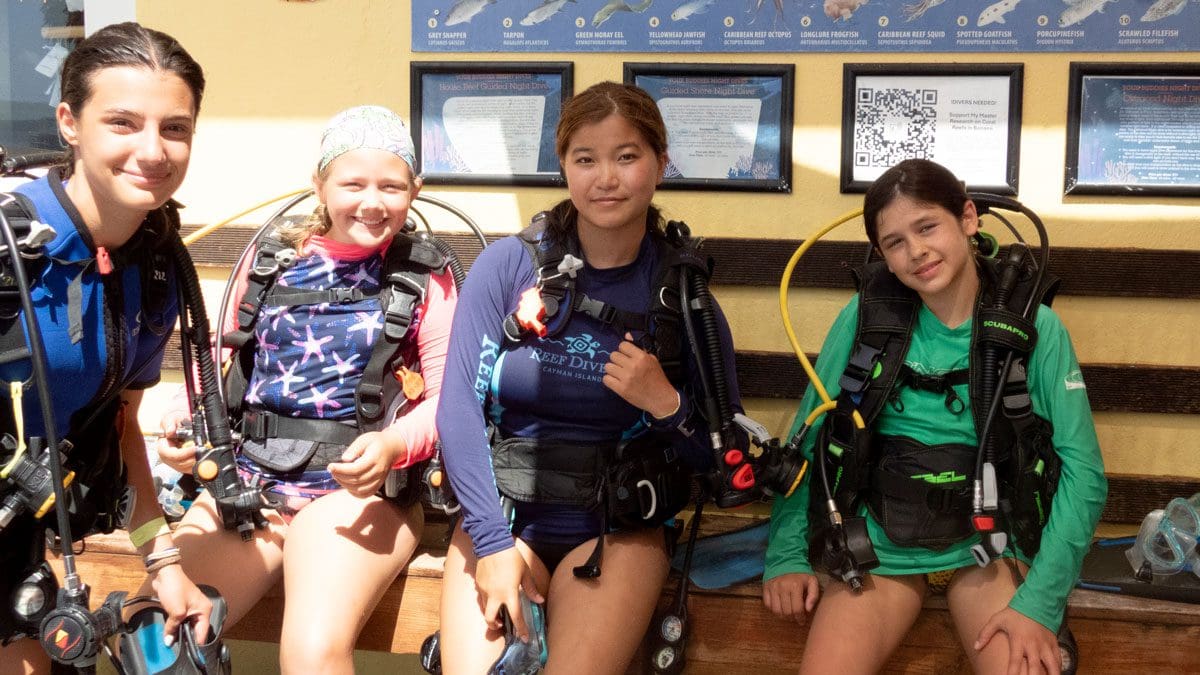
Before I did the open-water dives in the ocean, I had to complete my confined training dives in the pool. The Camp this week had a full JOW class of 12 kids, ages 10 to 15, with 4 PADI Instructors and other divemaster assistants.

The first day was challenging

On my first day, I learned how to set up and use my dive gear, including my BCD (buoyancy control device), regulator and gauges, air tanks, fins, mask, and snorkel. The first day was challenging, and I felt as though I’d never get it, but as the course progressed, I was required to take apart and reassemble my gear many times, and I began to understand. Over the three days of the course, I had it memorized and was ready to go each morning. My excitement towards the end of the week was to show my mom that I could get my gear set up and ready to jump off the dock and enjoy a dive with her.

During my course, I learned PADI diving skills and basic hand signals that evolved as we progressed toward becoming a diver.

Kids Sea Camp, becoming a diver, Kids and dive trainingFloating in divine heaven

The very first morning, I remember sliding my fins on and stepping into the shallow end of the pool with my gear on. We were split into our four groups, always with our instructors and buddies. We were practicing the pool skills we would use again in the ocean. My first breath underwater felt as if I was floating in divine heaven, the sun rays glimmering like golden gates through the water in front of me.

My excitement is bubbling inside me

On the day of my first open-water dive, we finished setting up our gear, had a dive briefing, and then a snack of green grapes. I remember my excitement bubbling inside me as I walked down the metal staircase that led into the calm, clear ocean.

The weight of the shiny grey tank decreased as I slipped into the water. I slid my long fins onto my feet as tiny waves lapped at my chest. My BCD, inflated with air, helped me stay afloat as I paddled over to my buddy, who waited patiently for the rest of us to join.

I dipped my face into the salty seawater and saw a bright teal parrot fish scuffling among the white sand and chipped pieces of coral that lay upon the bottom. My vision was a bit clouded by a light fog that blanketed the inside of my mask’s glass.

I learned to equalize my ears

When my head bobbed back up, Madi was looking at me expectantly. “Sorry,” I mumbled silently as she began to speak. The instructors briefed us on what we would be doing underwater. After we discussed the dive plan and signals, we held our deflator hose in the air and descended. I learned to equalize my ears.

I watched my buddy’s face light up as a small school of sparkling fish swam underneath us. One of them stopped to examine my fin, then kept swimming. My buddy Hadley was already ahead of me, waving for me to pull myself away from the extraordinary sights that I wanted to enjoy more of.

Signaling underwater

The other instructors and kids were diving alongside in their buddy teams as we headed to the training area. Vanessa turned to check on me as I had stopped again to observe two little angelfish swimming side by side. She asked, “Okay?” by making the okay sign with her hands. I nodded, making the same signal back to her.

As we passed a thicket of colorful coral, a huge yellow spotted eel emerged from its hiding place. Vanessa pointed to it, gave the diving group time to look, and we moved on. Another group of KSC kids, recognizable by their Scubapro dive gear, followed, their fins kicking through the water eagerly as they passed us by.

We descended to 20ft. I equalized my ears again. My buddy looked at me with a bit of concern in her eyes as she, too, equalized and then signaled, ‘Okay?’ I signaled back to her. We then watched a school of silverfish part as they swam past us.

UGH! The mask skill

My instructor, Vanessa, stopped again to check on us, then turned to point out a tiny spotted drumfish in a cleft within a piece of coral.

We finally reached the training area, and my instructor signaled to me to demonstrate the mask removal and replacement skill. If I didn’t have a regulator in my mouth, I would’ve groaned louder than the blue whale calls. This was not my favorite skill.

I had practiced taking my mask off many times in the pool, but I reluctantly nodded and peeled my mask off my face. Squeezing my eyes shut tight to keep out the salt water that would soon surround my face. My instructor’s hand was gently holding me so I could put my mask back on. Grabbing my scuba mask strap and pulling it over my head, pressing my mask against my face at the top, looking up, blowing air from my nose, and clearing my mask. When the flooding salty seawater had been emptied out of my mask, I opened my eyes.

Vanessa gave me an enthusiastic high-five and continued to ask the other students to remove their masks one by one. This was how we did each skill, one at a time, with big high-fives after each of us completed one. After our skills were done, Vanessa would take us on a short, fun dive.

Diving is so mesmerizing

She pointed into crevices to show us an octopus, and we saw white Spotted Drumfish and little fish called Sargent Majors. Vanessa loved pointing critters out to us, and we would bundle around her to peer at them, creating a pod of young divers. After the fun dives, although only for a few minutes, we would head back the way we came. My heart always sank as we came closer and closer to the end of our precious dives. I was snapped out of my thoughts one dive when my buddy rapidly tapped me and pointed to something exciting, like a long, white, and yellow-spotted eel dancing on the sand below.

On another dive, I looked up to see a massive silver fish with dark silver stripes jiggling out from its stomach and back; it was almost bigger than me. A Tarpon! My blue-gray eyes widened, and I signaled “cool” to my buddy, falling behind in the group as I stared at the Tarpon, its long fin disappearing into the water. Diving is so mesmerizing.

Time flies underwater

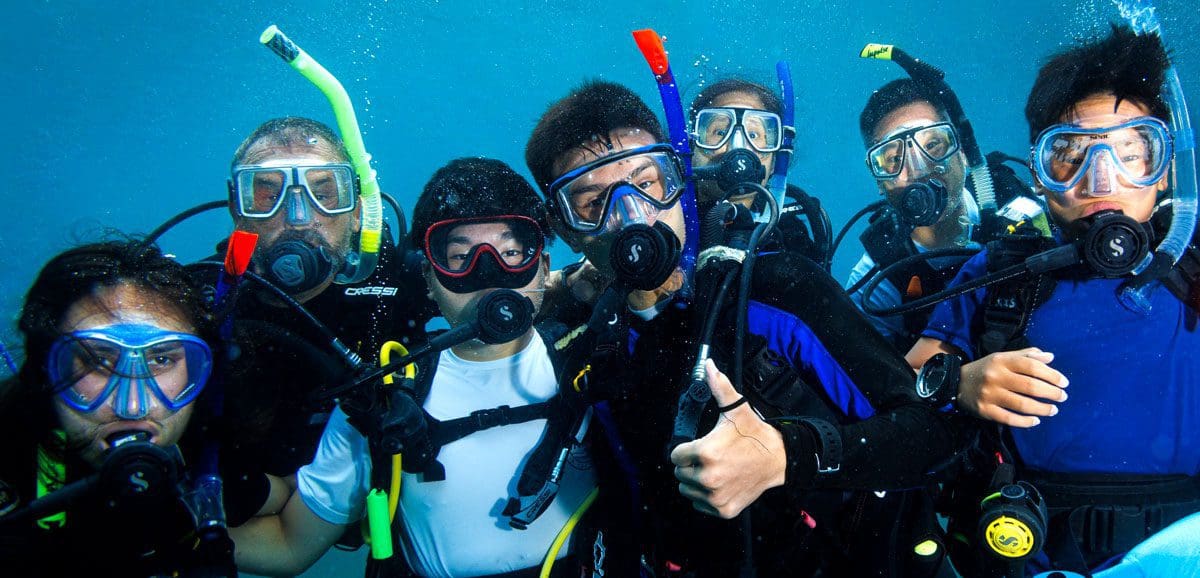
Twenty minutes could fly by, and it felt like twenty seconds. At the end of each dive, we headed to the Buddy Dive metal staircase that spiraled out of the water and up to the dock in front of us. Vanessa signaled “Okay?” to the diving group and instructed us to ascend slowly. We all gave her a final “Okay” as she lifted her inflator hose above her head, and we followed her like clones to the surface.

I inflated my BCD, feeling my weight lighten as I stopped kicking. Vanessa, taking her regulator out of her mouth, congratulated us on a class well done, and she climbed the stairs to the dock. She waved for us to follow, and I removed my regulator from my mouth. “That was so awesome!” I exclaimed happily after every dive.

Thank you, Mom and Kids Sea Camp

On Friday afternoon, while walking back to our room, past the Blennies restaurant and the turquoise water and white-sand beach, the colorful lizards scuttling along our path, the tropical birds singing melodies from the palm trees rising toward the still-bright sun, I shared my day with my mom. I thanked her for this experience, as it would stay a fond memory in my head and create a special place in my heart forever.

From SASY to Divemaster with Kids Sea Camp

Kids Scuba, Family Scuba Diving Adventures, Kids Sea Camp, Margo Peyton

SASY — I was only six years old

For as long as I can remember, I have spent every summer traveling with Kids Sea Camp. I lived in Grand Cayman with my family for the first 10 years, when I started discovering the underwater world. My dad enrolled me in the Kids Sea Camp SASY program (surface-supplied air system) when I was six. I remember running around on the beach collecting giant hermit crabs for the crab races and spending the afternoons learning about marine life and the local Cayman blue iguanas through dot painting classes with Margo Peyton and Ron Rogest. They would have us all saying, “One dip per dot and no double dipping!”

My love for the ocean

Kids Sea Camp, Camp, Kids and diving, Margo Peyton

As I got older and became more involved and interested in diving with Kids Sea Camp, I fell more in love with exploring the underwater world through photography. Margo Peyton, owner of Kids Sea Camp, and my dad introduced me to diving and encouraged me to share my story. I loved taking photos and videos of many incredible adventures with my Sealife cameras. Becoming a PADI Jr. Open Water diver at ten on a Yap and Palau trip with my dad, Tom, and Margo Peyton. I don’t think I was as big as the tank I used back then. My open-water dive with Margo was with Manta Rays, sharks, and giant Napoleon Wrasses.

Tom and Margo often had to hold my hands in the big currents because I was so tiny. I thought that was so much fun then. I grew up diving in currents, so as a teenager, I had so much fun body surfing and playing in them as I continued diving and traveling around the world with Tom, Margo, and my family. (See more about us)

My KSC world

My mom, dad, and I have toured most of the KSC World, including the Galapagos, where I lost all fear of sharks and had so much fun playing with sea lions and seeing my first whale shark. Dad and I dove into the Cathedral under Darwin’s Arch and watched Bullsharks and hundreds of Hammerheads go by. In Fiji, I dove with my very first Tiger sharks and more bull and lemon sharks. My mom was not with us on that trip, but when she saw the photos I was posting on my FB, she suddenly realized they were mine, not Dad’s, and that he had me in the water with big sharks.

Experiencing all that Kids Sea Camp had to offer from such a young age inhibited my love for the ocean and diving and made me want to be more involved in this organization and the diving world. Not only has Kids Sea Camp allowed me to travel to excellent dive sites and experience such incredible things, but it has also allowed me to meet some amazing people.

My first Kids Sea Camp

I remember my first Kids Sea Camp: walking onto the pool deck in Grand Cayman and meeting another girl named Holly. We became best friends instantly and were inseparable throughout the whole two weeks. I longed for my Kids Sea Camp summers and for meeting up with Holly; we always wanted to make sure we were on all KSC trips together, and as we advanced in the diving world, our love for the ocean and our friendship grew. Holly became my dive buddy for nearly every dive I did over the years, thanks to Margo and Tom Peyton, who took us on trips. Many other kids did multiple internships with Kids Sea Camp.

As I became more involved with Kids Sea Camp, I learned a lot about SeaLife cameras from Margo and my dad. I hosted a few demonstrations, and Margo worked with me and directed me toward becoming a better underwater photographer. I have always wanted to be a part of the KSC dive team and help further its mission of teaching so many young people about the thrilling sport of scuba diving.

Becoming a PADI Pro

Margo and Tom offered me a chance to become a PADI DM Pro in 2022 at Buddy Dive Resort in Bonaire. They entirely sponsored my program; it was the best place for me to do my divemaster course. The Buddy Dive team was outstanding as they cheered on my attempt at lugging tanks up the dock, and the coral restoration projects there made my dives much more enjoyable.

What greatly added to my experience on every trip was, as always, my Kids Sea Camp instructors. I learned from them and was treated like family. They forever changed my scuba-diving experiences by creating moments I will cherish forever. Being able to not only grow my love of the underwater world and scuba diving but also build such strong bonds through it has been a fantastic experience. Without Kids Sea Camp, I would never have met or made all the incredible friends I still have today. Kids Sea Camp also made me want to keep expanding my diving knowledge and helped me gain a lot of confidence underwater. I hope to continue my adventure with Kids Sea Camp and become an instructor someday. Scuba diving has made me adventurous and courageous, and given me a global perspective.

By Sophie Purdon, I look forward to sharing all that I shared with the next generation.