How to equalize or clear your ears when diving?

ear cleaning, kids and diving, scuba skills

What if you could prevent equalizing issues and never miss a dive again?

89% of divers do not equalize correctly, and 29% have had to stay out of the water for days, weeks, or even months due to problems caused by incorrect equalization. It’s hard to think that you could be part of the 6.3% of divers who now have permanent ear damage caused by pushing too hard and trying to force their ears to clear. This should be taught in your open-water class, or even in Discover Scuba, swimming, and snorkeling classes. It is the most common reason adults and kids do not continue diving or complete their courses, or dive after their courses.

As long as you have no physical reason you can’t equalize and have been advised by a doctor, this is not an activity you can partake in, then let’s make equalizing problems a thing of the past.

As beginner divers, we are taught to pinch our nostrils and blow against a blocked nose. This technique results in overpressure at the back of your throat, forcing air up into the Eustachian tubes and creating a ‘popping’ sound in your ears.  This works for many divers, but for others it does not work or can cause ear damage, nosebleeds, or headaches.

 This technique does not actively engage the muscles in opening the Eustachian tubes. If you do use this technique, make sure you do not maintain pressure for more than 3 seconds and do not blow too hard. Remember to ascend slowly, releasing the pressure if you feel pain, and before you blow.

There are 5 better, safer, and healthier ways to equalize

  1. Toynbee Maneuver: Pinch your nose and swallow at the same time.
  2. Lowry Technique: Pinch your nose, blow against your nose, and swallow at the same time.
  3. Edmonds Technique: Pinch your nose, blow against it while moving your jaw forward and downwards.
  4. Frenzel Maneuver: Pinch your nose and make the sound of the letter ‘K’ at the same time.
  5. Voluntary Tubal Opening Technique: Tense your throat and push your jaw forward and downwards.

These five techniques and maneuvers will change the way you dive for the rest of your diving life.

If you would like to learn more about equalizing and the potential issues you face if you don’t equalize correctly. As well as new and safer ways to clear your ears on a dive. DAN Ears is my number 1 resource for dive medicine and advice.

equalizing, diving, clearing your ears

Dive Vacation checklist for Kids Sea Camp

Black divers, Asain divers, family dive vacations, kids sea camp

It’s time to prepare for vacation.

Here’s a great dive travel checklist—a detailed “know before you go” reminder for your next Kids Sea Camp adventure.

Trip planning 

  • Check the KSC calendar
  • Weather and clothing needs
  • Currency exchange or credit cards accepted
  • Call your credit card company and tell them you are out of the country
  • Valid passports
  • Medical treatments available
  • Check airline reservations
  • Distribute your international vacation plans to a friend or family member who needs to know
  • Travel insurance
  • Emergency phone number

Kids Sea Camp, diving with Kids, diving with family

Must-haves for your carry-on bag

  • Snacks
  • Reg and dive computer
  • Swim shorts
  • 2 extra shirts
  • Passports
  • Dive cards

Dive Travel Checklist  

  • Check all your equipment
  • Suppose your diving equipment has not been serviced in two years. Get it serviced!
  • Certification cards (for the whole family)
  • Dive computer batteries (make sure they work!)
  • Logbook
  • Bring an extra mask fog
  • Bring a spare mask
  • Prepare your new mask (use the overnight toothpaste process)
  • Super Glue
  • Bring a small first-aid kit, or ensure the dive shop has one on each boat and at the resort. (All Kids Sea Camp resorts do, by the way)
  • Extra sunscreen
  • Motion sickness pills
  • Aspirin
  • Nasal Decongestant
  • Meat Tenderizer
  • Dive lights
  • Gloves (If allowed)

The vacation is over list

  • Double-check all your family’s dive gear, including BCs, fins, masks, snorkels, and wetsuits. This is a no-brainer, but it assumes you will lose something if you don’t double-check all the gear.
  • Airline tickets: Check in online the day before
  • Check out all the new photos in the KSC gallery.

At home

  • Thoroughly rinse all gear and allow for proper drying
  • Repeat gear double-check
  • Put dive gear in an organized space (This makes the next dive trip easier to prepare for)
  • Replace used items with spare parts and medical supplies
  • Write a thank-you email to Kids Sea Camp for such a great vacation.

Philippines: The jewels of the visayas sea

Kids Scuba, Family Scuba Diving Adventures, Kids Sea Camp, Margo Peyton, Whale Sharks, Family Scuba Diving Vacations, Family Dive Adventures, The Philippines

Welcome to the jewel of the Philippines

Our children’s world has become much larger as today’s technology helps us to engage “virtually” in ways we never dreamed possible. However, beyond our smartphones, there is still a big, beautiful, real world out there. It’s filled with the kind of learning and adventure that expands our hearts and minds in a way technology cannot. The adventure in the Philippines is a jewel of a diving vacation.

When we travel with our children, we provide them with personal experiences that they’ll carry with them for the rest of their lives. If you’re eager to plan your next scuba diving adventure as a family, here is the latest off-the-beaten-path treasure that Tom and I have just explored and that Kids Sea Camp has approved.

Islands in the Visayas Sea

Upon landing on the main island, Cebu, we were met with friendly smiles and helpful hands. Biggs Eggert with Sea Explorers provided us cool face cloths, bottled water, and hugs. We quickly headed to board a Banca boat, which reminded me of a giant bamboo water spider; it was spacious and smooth sailing, like a mystical chariot to our first dive location.

Malapascua has become well known as a premier dive destination fairly recently

This tiny island, just a little more than a mile long, is home to several villages that exist either directly or indirectly to support the growing dive tourism industry.

I have read that Malapascua is the only known place on Earth where one can dive with the endangered thresher sharks and, as I prefer, in a natural setting on seamount cleaning stations at Monad Shoal. Biggs said we would dive with the sharks at sunrise, and as crazy as that sounds, it was not hard at all. Jet lag combined well with the time lag, and we were wide awake and ready to dive at 5 A.M.!

Thresher sharks

Thresher sharks have been on my wishlist for many years, and seeing them on every dive far exceeded my expectations. The shoals also attract devil rays, pelagic fish, and hammerheads; more than enough to thrill any diver. Families can enjoy diving the coral gardens, coral walls as well as further-out sites including Gato Island and Kemod Shoal.

Malapascua has at least 20 dive operations and hotels situated along Bounty Beach; however, Tom and I found only two properties we would deem as family-friendly. Ocean Vida and Buena Vida both have connecting rooms, family-friendly food, and kid-friendly staff. Ocean Vida is oceanfront, and Buena Vida is right in the middle of the local village, hosting an amazing spa and restaurant that would please any palette. Gourmet breakfasts, vegan and vegetarian dishes and fresh seafood are featured.

Sea Explorers a PADI five-star IDC

Sea Explorers, a PADI five-star IDC, is our No. 1 pick for diving and island hopping throughout the islands of the Visayas Sea. Exceptional service and knowledge, smaller dive gear, tanks sized for kids, and a well-trained staff for all levels of divers. They easily accommodate big-rig photographers, single families, and large groups like ours. Each Banca boat offered hot coffee or tea, warm face cloths, fresh fruit, and baked bread upon returning from our dives. To top it all off, I never touched my gear; it was rinsed and set up perfectly adorned atop my nitrox tank, awaiting my return. Heaven! I have to say, nothing made the staff happier than to see the smile on our faces, and I guess that’s why the Sea Explorers’ tagline is “Dive with a smile,” because we certainly did.

Negros Island was our next stop

We were beyond surprised when we arrived at Pura Vida Homes. Fourteen luxurious two-bedroom villas are handcrafted with rich hardwoods and have breathtaking views of the mountains and sea. The resort sits on a beautiful beach with three infinity pools, a restaurant, a gym, a spa, and a wedding chapel.

Being that it was our 10th wedding anniversary, we could not resist the opportunity to renew our vows at sunrise. Owner Chris Heim was delighted to give me away. Biggs accepted as my maid of honor, and the local pastor presided, as his lovely daughter sang. I have no words for how special Sea Explorers made us feel throughout our trip. They treat everyone like family.

There were mountain villages to explore, and infinite pristine reefs teeming with fish to dive, like Apo Island, which provided endless views of colorful soft corals, punctuated with my favorite, turtles! We could have stayed a month and not been bored.

Whale sharks

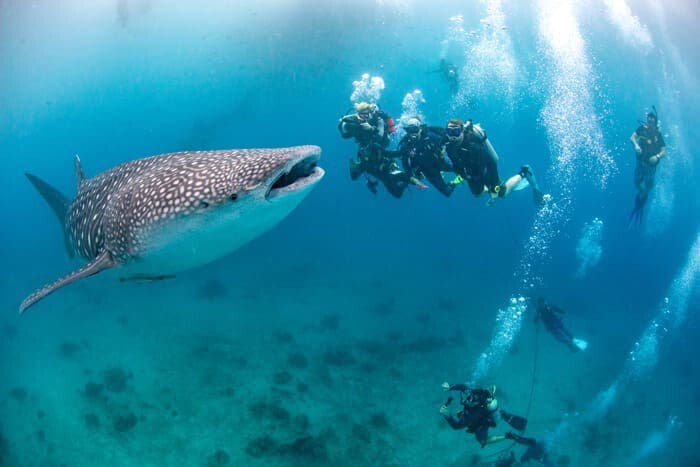
On our way to Bohol aboard our Banca boat, Dako, we were able to dive in 35 feet of warm, clear water and observe these gentle giants feeding on krill. I had only been diving with whale sharks in the Galapagos, and it was fabulous in these much warmer waters. Kids and families can snorkel or dive anytime during their stay.

Amun Ini is a small 16-room, five-star dive resort and the most luxurious little gem we found yet. Family-owned and family-run.  Amun Ini means “This is mine,” and I can understand why, as anyone would want to claim it for themselves. A beautiful, private white sand beach, infinity pool, and large, spacious rooms greeted us at this eco-friendly, holistic, and organic scuba retreat.

Did I mention it’s kid-friendly?

The owner’s daughter and her husband are the gourmet chefs, who create local dishes that will tantalize your taste buds and make you feel like you’re dining in one of the top 10 restaurants in the world. Did I mention it’s kid-friendly? The chef’s two little girls, ages 3 and 5, joined us each day. I loved seeing the smiles on their faces when I told them about Kids Sea Camp and all the kids we would return with to play together in the ocean.

Beyond diving, I must mention the things Tom thought were more than noteworthy. Everyone in the Philippines plays basketball,  and they are really good at it too! Tom played a few games after diving with the dive team, and it was almost as good as the diving.

In addition, there are sunset massages, culinary classes, yoga, and kayaking. We also enjoyed the many hugs from some of the happiest children we encountered throughout our trip. These are humble people who prize family and each other above all things.

The diving had the most incredible, healthy, and vibrant reefs I have ever seen. Biggs asked me if I wanted to do some muck diving. I had read about this type of addictive diving, hunting for the tiniest of critters on the sandy bottom. I found tiger shrimp the size of a grain of rice, multicolored frogfish the size of a gumball, and pygmy seahorses, all well camouflaged to the eyes of any would-be predators.

Cabilao Island, our next stop via the Chocolate Hills

The hanging bridge and a zip line to stay at Pura Vida Cabilao. Another spectacular Sea Explorer resort with 2O spacious oceanfront suites, more breathtaking views, and completely surrounded by endless coral walls. The unlimited shore diving offered many opportunities to encounter a wide range of tiny critters, turtles, rays, sharks, and even schools of wild dolphins.

This boutique island resort offers a personal closeness that is perfect for small groups and the Kids Sea Camp. The dining offers a personalized touch with a menu prepared to please.

A welcoming, safe, and smile-driven island

All in all, we have given a good chunk of our hearts to the Philippines, as we found it to be one of the most welcoming, safe, and smile-driven places we have encountered to date. If you’re ready to take a break from your virtual world, I invite you to taste experience to the utmost, to teach your children to reach out without fear to explore a world that will bring their imagination to life.

Join us for an extraordinary journey to the Philippines. I encourage you to open your children’s eyes to humility, happiness, and a new way of looking at life that they will remember forever.

By Margo Peyton, President of Kids Sea Camp Inc. 

Kids Sea Camp Bonaire: Diving for The Teens

Teen diver, Kids and Scuba, Bonaire, Kids Sea Camp

I can’t wait to go back

Although this was my second time participating in the Teen Diver group during Kids Sea Camp Bonaire, it was still an awesome week. I saw a lot of things I hadn’t seen in the water last year, and going back to the donkey sanctuary was pretty sweet. And even though Bonaire is a small island, I am never bored there, and I can’t wait to go back again.

The diving was really cool, yet again. There were many fish, and the water was warm and clear. I even had the experience of seeing my first manta. It was also nice to see Charlie the Tarpon again. That’s certainly one way to know you are at Buddy Dive in Bonaire.

Meeting new friends

While in Bonaire, I was able to see my old friends and make a few new ones. If you are a teenager and you’re sick of your friends back home (no offense to all of you), Kids Sea Camp is the place to be. You are guaranteed to make friends, especially in Bonaire, where many families go (mainly because it is the cheapest Kids Sea Camp, and what parents don’t like is going diving for as little money as possible?). The other good thing about Kids Sea Camp Bonaire and being a teen diver is that you are ALWAYS with your new friends. That is what makes Kids Sea Camp so much fun.

Bonaire is a great place for teens, especially for a Kids Sea Camp, because school just ended. I like to think of it as a way to celebrate the end of the school year. If you treat Bonaire like a celebration for any occasion, you and your friends are sure to have a great time.

Buddy Dive is a great place for us teens to have a good time because there is a lot for us to do at the resort, and there is a really good ice cream store two blocks away. Who doesn’t like good ice cream on a hot Caribbean day? We can also go swimming (pool or ocean) and jump off cliffs into the water (tell your parents it isn’t THAT high, but it’s high enough to get some good hang time).

Rogest

This year, we had the experience of Ron Steven (better known as Rogest) coming to Bonaire. Although Ron seems like the kind of guy who would appeal more to five-year-olds, I think he is one of the coolest people you can have a vacation with. He is funny, he will make you a better artist, and he is just a great source of entertainment. He also likes to embarrass you in a funny way that won’t make you too mad; you’ll end up laughing.

I would recommend Kids Sea Camp Bonaire to all of you teen divers. It is a fun place, and the diving is great whether you have been certified for 5 years or are still a beginner diver. And to the parents who have never been to Bonaire, it’s a fun place for you, too. Don’t even worry about your teens during the day, Buddy Dive and Kids Sea Camp make sure we are all safe and having a great time.

By: Ryan Seltz

Tips for better buoyancy and air consumption

Buoyancy, Kids Sea camp, scuba training for kids

Keys to better diving

  • Good buoyancy is key. Make sure you are neutrally buoyant, trim your gear so nothing is hanging or dragging below you, and try to evenly distribute your weights. 4lb on the left, then 4lb on the right. Move them around, ankle weights are also used, I use 1lb on each ankle when diving with my camera. Some BC’s, like my ScubaPro Lady Hawk, have pockets up high in the back. I often put a 1 lb in each of those pockets. A Peak performance buoyancy class will be a fun continuing education class, as it will teach you more about good buoyancy control.
  • Breathe slowly and deeply when you’re diving; don’t ever hold your breath. Short and shallow breaths can be dangerous and create dead air spaces.

Gear is important

  • Streamline your gear and have property-fitting equipment, nothing dangling or dragging. Make sure your equipment is in good working order and has been serviced regularly by your local dive shop.
  • Use proper kick cycles and don’t swim while diving (no hands needed). Make sure you’re using Scuba fins, not snorkel fins. Dive fins should be longer and fit comfortably. Go to your local dive shop and try on a few pairs. Some adults like me prefer full-foot fins; for kids, I recommend fins with straps for growing feet.
  • Make sure to be suited up as conditions dictate. Stay warm, choices of a shorty or long wet-suit, 2 mm, 3 mm, 5 mml and more are available depending on the temperature of the water your diving. In the Galapagos, I use a 5- or 7-mm long suit; in Bonaire, I use a 2-mm shorty. New wetsuits are more buoyant than older ones, and thickness makes a big difference as well. The thicker the suit, the more weight is needed. Long suits will require more weight than a shorty.

Be in good condition

  • Be in good physical health, and never dive when you’re not feeling well. Always consult your doctor about any medications you’re taking, as they could have different effects while diving. Make sure to fill out waivers truthfully so that, if something does happen, it will be easier to determine what is going on and to provide help faster and more efficiently.
  • Dive often. The more you dive, the more confident and comfortable you will become, and buoyancy will become easier.

Be a good buddy

  • Stay close to your buddy. Constantly chasing your buddy can use up more air on a dive and create stress.
  • Dive into a current at the start of a dive when you are not tired, so you can then dive with the current returning at the end of your dive. Make sure not to dive in strong currents. Check with your local dive shop or dive professional before entering the water to determine safe dive conditions. Always let someone know you are going diving, and never dive alone.

Relax, it’s just diving

  • Relax, enjoy your dive. Take only photos, leave only bubbles. Observe marine life and don’t touch anything living.
  • Take an advanced open water class, which covers a navigation dive, a deep dive, a buoyancy dive, a night dive, a photography dive, and a Fish ID dive. All of which will make you feel more confident in your direction, buoyancy, and knowledge of marine life, allowing you to feel more comfortable diving. There are other specialty dives you can take in an Advanced Open Water Class, such as Underwater Naturalist, Wreck, or even zombie dives. Visit www.padi.com for more information about courses.
  • Don’t overthink air consumption; the more you think about it, the more anxious you become, and the fewer chances there are for relaxation.
  • Take your family diving and enjoy diving with your kids. They will look to you as role models and strive to dive as you do. Be a good role model.
Have fun and be safe! I look forward to diving with you.
by Margo Peyton, President of Kids Sea Camp, PADI Instructor #57474

Kids Sea Camp Dive Vacation tips

Buddy Dive, Bonaire, Kids Sea Camp

Tips for a better dive vacation!

It’s time — you have been waiting all year for the summer dive vacation. You’re so excited, so pumped up to head to your tropical vacation that you forget the sunscreen or worse, the passport. We have had families forget: Dive computers, cameras, passport and yes even the dates they are traveling. But you may be a bit rusty here are some vacation tips for diving this summer.

So take your time and prepare for your dive vacation. Plan a day to pack and make a list of all the important items you need to bring to make your holiday easy and fun. Over the years, Margo and I have noticed there are a few things to remember for a better dive vacation. Some of the items are easy to remember — some are less obvious.

Get ready for the adventure of the Kids Sea Camp summer!

  • Check your equipment! Make sure you have it all! We’ve never had anyone forget all their equipment, but a mask, their fins, a dive computer or even their BC. It happens.
  •  Make your equipment yours: Mark your equipment with your name or symbol before you’re on the boat. It all sorts of looks the same once you’re on the boat, and it helps the dive shop to organize your equipment.
  • Don’t forget toothpaste for your mask.
  • Bring a spare dive computer: All the resorts have dive computers, but they may not match your equipment.  So if you have an extra computer — bring it. It is the number one issue we find with our equipment — most of the time it’s a failing battery. But the dive show may not service your brand equipment.
  • Defog: And just in case, get your defog before heading to the island. All the dive boats have some, but we always make sure to have the defog with us. A clear mask is a good choice for a dive mask.
  • Pack your Certification Card and logbook.
  • Bring your boat items, like sunglasses, rain gear, and comfortable boat shoes.
  • Dive insurance: Margo and I carry Dan dive insurance all year round. Diving is a very safe recreational sport — but sometimes you just never know. And when it comes to our kids in a foreign country, we want the DAN protection.
  • Bring your medical items
  • Passports (Duh — right?) Well, Margo and I once got in such a hurry that we forgot our passports.
  • Check your flights the day before. We have a couple of families who have forgotten their flight dates. The story to get them to the airport is worth a beer or two.
  • Credit cards: Call before you leave and tell the company that you will be in a foreign country.
  • Ziploc bags
  • Baggage limits: Most airlines have a 50-pound weight limit for coach and one bag per person. First class normally weighs 70 pounds and includes two bags per person. We’re divers, so bringing our equipment is important. Just double-check the weight; the surcharge can run into the hundreds of dollars.
  • Passports (in case you have forgotten already)
  • Pack your patience: Expect delays —traveling to any island really is a delay waiting to happen. So have fun, be patient, and enjoy your Kids Sea Camp summer.
  • Buy travel insurance: Kids Sea Camp buys DAN travel insurance on every one of our trips. Margo and I both know we have been lucky with great weather over the years —but we also know we don’t control it. Things happen; it’s just that simple. Be prepare. Please note: Some credit cards offer very good travel insurance as part of the card membership.

Toothpaste and new dive mask

Bonaire, Diving with Kids, Tom Peyton

Preparing a new dive mask

The foggy mask: I had a client buy a new dive mask this week, and I told him to make sure to rub toothpaste on both sides of the mask lens before jumping into the water. It will help prevent the lens from fogging up.

He then asked a very simple question, “Why?”

I had no answer for him—I said it was tradition. He then asked, “But why is it the tradition?

I smiled and thought to myself how living with a Hall of Famer who really is a diving professor, Professor Margo of the department of Oceanic Adventures at Kids Sea Camp, makes me a little dumb at times. I have watched Margo put toothpaste in our new dive masks for years — she even puts it in the old ones at the beginning of the summer. And the dumb part  — I never once asked why. Not once did I ask why we are putting something I put on my teeth every day on an item that has no teeth? I just knew that when she didn’t use the toothpaste, my mask would fog up — very quickly — and I hate a foggy mask.

One good thing about myself is that once I realize just how stupid I’m acting or thinking, I tend correct my behavior, and I do this by gathering information. So here’s why my Oceanic Professor puts toothpaste on the lens of our mask almost every year, at the beginning of our diving season— new or not.

Toothpaste is a mild abrasive

Most newer masks, frames, skirts, and straps are made of silicone, which creates a film on the mask’s lens. The film on the lens blocks the defog from working properly. In fact, if the silicone residue is not removed, any amount of defogging work on the lens.

After the toothpaste

After you have cleaned off the toothpaste and you are heading to the boat, make sure to have some defog. There are many brands, and with the silicon residue removed, most of them will work. The fact of the matter is, all the dive boats have some form of defog, though most use a watered-down J&J baby shampoo.

Other forms of defogging

Spit: Real divers don’t use defog; they spend a lot of time draining their mouths, building up a large quantity of saliva, and projecting it into their masks. Many divers say this is the best form of defog, but the idea of my eyes breathing in all the wonderful germs from my mouth — just doesn’t work for me.

SeaDrops: Clean, quick, and easy to use — a few drops on the inside and the outside of the mask has gotten me close to a decade of “no fog” mask. Just remember to wash the drops out right before you jump off the boat. If you don’t clean the drops out of the mask properly, you could experience a severe burning sensation in your eyes — and the eye burn can really ruin a great dive. Why? Because all defog is a form of soap. That’s why most dive boats and shops use J&J Baby Shampoo  — it’s easier on the eyes.

Burn it off: Don’t do this at home unless you know a professional mask burner who has done it many times. You are basically burning off the thin film that protects the new lens. The danger, of course, is burning the entire soft silicone that makes your new mask so darn comfortable.

After the dive

Hit the dunk tank: Make sure you use freshwater to clean off all your dive equipment. Almost all our family of divers dunk their BCs in the sweetwater tub, but I have watched numerous divers forgo a quick rinse of their fins, mask, snorkel, and wetsuit. Remember, a clean mask doesn’t fog up as much, and clean gear lasts longer.

Tom Peyton, Vice President of Kids Sea Camp and Family Dive Adventures

Tips for a happy Kids Sea Camp

Kids and scuba, Kids Sea Camp

It’s Christmas in May at Kids Sea Camp!

It’s May, but we are less than 30 days from the launch of the first Kids Sea Camp week. We are busy finalizing our family packs, forms, and payments for the start of our summer vacation season. You should be receiving the Family Dive boxes full of goodies for the trip. But here are a few things to do or think about before you enjoy your summer vacation with Kids Sea Camp.

Top 10 tips for a happy KSC summer

  1. Gear up: Either get your gear serviced ASAP. Having faulty gear ain’t no fun in the middle of the South Pacific. And even worse, unsafe. If you have older gear, take a look at our online store. We have numerous ways to “gear you up” and still save cash.
  2. Passports: Make sure they are up-to-date. You can get “rushed” service, but on this date, you’ll be cutting it close.
  3. Docs: Print out your documents and have them in place. That will remind you how close you are to the KSC summer. Expect us to email or call you if you are missing any of our FDA/KSC forms.
  4. Calendar: Mark on your Google calendar your travel dates, and then have alerts on your phone. Just in case you get too busy to remember, you’re going on vacation. It happens even to some of the smartest people we know. (See KSC Calendar)
  5. Questions: Call us at 803-419-2556 for any questions about the resorts and the diving your family will be experiencing. We will field any questions, and if we don’t know the answer, we will find it.
  6. Get a tan: I know. I know what you’re thinking. Doesn’t Tom think the sun causes skin cancer? Yes, I’m not telling you to get a burn. In fact, I recommend a little time in the sun before you’re on the island so you don’t burn. Sunscreen is great. But a little layer of gentle, healthy color sure can go a long way on the island.
  7. Practice island time: Before you go… get lazy. Do nothing for a day. Imagine not worrying about work. On average, it takes three days for a vacation to start easing stress and pressure. What does that mean? It means that the benefits of vacation don’t kick in until it’s half over. But if you practice being on island time before you’re on the island, maybe you can gain a day or two. Make your vacation dollars work for you. Relax now!
  8. Exercise: Our trips are adventure trips. You are out in the sun and the ocean all day on our trips. Now that being said, we don’t run a Kids Sea Camp Ironman contest, but the better shape you’re in, the more you will enjoy the week. You have 30 days until Utila, and then the Galapagos. Get busy, Kids Sea Campers, we want everyone happy and healthy on our trips.
  9. Educate: Get online, read about the resort, the island, or learn about the critters and animals you will see.
  10. Visualize: Imagine this year’s KSC vacation better than any before. Imagine great tropical weather, happy faces, young and old, amazing diving, and safe, secure travel. Margo and I always prepare for the best and pray for even better. And right now, Margo is probably daydreaming that this year’s Utila trip is as good as last year’s.

Ear clearing techniques for divers

ears and diving, kids sea camp, clearing skills

You just can’t go diving with your ear blocked

Ear clearing and diving go hand in hand when you jump into the ocean. Here are a few ear-clearing techniques for divers that will help most divers equalize more easily.

In diving, the Valsalva maneuver is often used during descent to equalize the pressure in the middle ear with ambient pressure. Performed properly — pinching your nose shut while exhaling — most divers can descend without any problems. But for some divers, the technique doesn’t help.

You should never continue with descent if you are experiencing ear pain. But before you give up on a dive — or diving altogether — try a few of these ear-clearing techniques and suggestions.

  • Listen, you should hear a “click or pop.” Before you even board the boat, make sure that when you swallow, you hear a “click or pop” in both ears. This tells you that both Eustachian tubes are opening.
  • Start early. Several hours before the dive, begin gently equalizing your ears every few minutes. Some people can swallow or chew gum to clear their ears; this seems to help because it prompts them to swallow more often. I don’t recommend chewing gum while diving, as you may swallow it and choke.
  • Equalize at the surface. “Pre-pressurizing” at the surface helps most divers get past the critical first few feet of descent. It may also inflate your Eustachian tubes, making them slightly larger. Not all medical authorities recommend this, however. The lesson here is to pre-pressurize only if it seems to help you and to pressurize gently.
  • Descend feet first. Studies have shown a Valsalva maneuver requires 50 percent more force when you’re in a head-down position than head-up.
  • Look up. Extending your neck and wiggling your jaw tends to open your Eustachian tubes.
  • Use a descent line. Pulling yourself down on an anchor or mooring line helps control your descent rate more precisely. A line also helps you stop your descent quickly if you feel the pressure. Don’t rush just because others are faster. If you know you have trouble, let your buddy and/or the divemaster know so that someone is waiting with you. If on a recreational dive boat, the divemaster could give you a little more time by getting in first.
  • Stay ahead. Equalize often, trying to maintain a slight positive pressure in your middle ears. Don’t wait until you feel pressure or pain.
  • Stop if it hurts. Your Eustachian tubes are probably locked shut by the pressure differential. Ascend a few feet and try equalizing again.
  • Avoid milk. Some foods, including milk, can increase your mucus production.
  • Avoid tobacco and alcohol. Both tobacco smoke and alcohol irritate your mucus membranes, promoting more mucus that can block your Eustachian tubes.
  • Keep your mask clear. Water up your nose can irritate your mucous membranes, which then produce more of the stuff that clogs.

If you get congested during the dive and have trouble ascending, stop and try to clear, then ascend slowly. Use the anchor line if you need more control. Don’t dive with a cold or congestion.

Alternative Clearing Techniques

There are problems with the traditional Valsalva maneuver: It may not work if the tubes are already locked by a pressure differential, and it’s all too easy to blow hard enough to damage something. Divers who experience difficulty equalizing may find it helpful to master some alternative techniques.

  • Toynbee Maneuver. With your nostrils pinched or blocked against your mask skirt, swallow. Swallowing opens your Eustachian tubes, while the movement of your tongue, with your nose closed, compresses air against them.
  • Lowry Technique. A combination of Valsalva and Toynbee: while closing your nostrils, blow and swallow at the same time.
  • Edmonds Technique. While tensing the soft palate and throat muscles and pushing the jaw forward and down, do a Valsalva maneuver.
  • Frenzel Maneuver. Close your nostrils, and close the back of your throat as if straining to lift a weight. Then make the sound of the letter “K.” This forces the back of your tongue upwards, compressing air against the openings of your Eustachian tubes.
  • Voluntary Tubal Opening. Tense the muscles of the soft palate and the throat while pushing the jaw forward and down as if starting to yawn. These muscles pull the Eustachian tubes open. This requires a lot of practice, but some divers can learn to control those muscles and hold their tubes open for continuous equalization.

How safe is scuba diving?

Kids Scuba, Family Scuba Diving Adventures, Kids Sea Camp, Margo Peyton, Family scuba diving

Jerry Seinfeld is wrong. Scuba diving is safe.

This morning, seeking inspiration to write, I listened to Seinfeld joking about scuba diving. He observes that scuba diving is the only activity where your main goal is simply not die. You spend the whole time thinking, “Don’t die… swim and breathe because living is good.” Comedy aside, let’s look at the numbers. While Jerry is a master of comedy, his take on diving falls short. Scuba diving is, in fact, exceptionally safe—even when sharks are involved. The reality is that diving ranks among the safest activities you can choose.
Scuba diving versus other human activities

By the numbers

Scuba diving death rate: 1 out of every 211,864 dives ends in death, according to DAN (2010 workshop report). For example, with about 2,000 dives in my scuba career, my statistical risk is roughly 1 in 106,000. Margo, with 7,500 dives so far, would have a statistical risk of approximately 1 in 28,000. However, these numbers show that scuba diving remains statistically safe. In fact, a DAN study on DCS (Decompression sickness) states that from 1998 to 2004, across 105,135 dives, 95% were “uneventful.”
To clarify, this means that the vast majority of dives encountered no significant issues. Of the 5% who experienced problems, the most common, affecting 2.7% of dives, was equalization, which simply involves adjusting ear pressure to accommodate underwater changes. Buoyancy control, which is adjusting your body’s position in the water, was a problem in 0.9% of dives. The face mask was the next issue at 0.69%, with dive computer issues trailing at 0.4%. Overall, diving seems pretty darn safe.
Shark accidents: Just because it’s fun to talk about sharks and diving, and at one time, one of my biggest fears, sharks will kill me. It is simply not true. While the number of attacks fluctuates slightly year-to-year based on beach attendance and environmental factors, the overall danger remains minuscule: Average Attacks: Recent years (2020–2025) have averaged roughly 63–80 unprovoked bites per year. Fatalities: The global average for deaths remains around 5 to 6 people annually, which is incredibly low considering the millions of people who enter the water. Odds: The statistical likelihood of being killed by a shark is approximately 1 in 4.3 million.
  1. Human accidents: As far as the sharks that are reading this blog, well, our ” finned friends” need to stay away from us. Sharks vs. humans — humans win, we kill about 100 million sharks a year. Most of it is due to “finning”.
  2. Car accidents: I would advise not getting in your car today. To make this comparison fair, let’s look at it this way: for every 10 million car trips taken in the U.S., approximately 180 end in fatalities. This method makes it clear that, relative to scuba diving, the dangers of everyday car travel are notably greater.
  3. Birth: This is not the stat of the week at all, but giving birth can be risky. 1 out of every 7,692 women dies due to complications in childbirth (NCHS).
  4. Jumping out of an airplane: First, if you’re doing it, God bless you. Margo has done it, and she says she still misses skydiving. But ain’t no way I’m jumping out of a perfectly good airplane. Anyway, the rate is not as bad as I thought. 1 out of every 116,666 skydives ends in death. So I guess, keep “free falling”, without me. (United States Parachuting Association)
  5. Running: Being healthy can be dangerous. For comparison, 1 out of every 126,626 marathon runners died of sudden cardiac arrest during a run (1975-2003, NSC), highlighting how rare this event is.
  6. Falling out of bed: To put all this in a better light, falling out of bed is a real killer. In any single year, 1600 or so people will die by falling out of their beds.

The data is clear—Let’s go diving

So it seems that, based on available data, the risks associated with being underwater may be lower than those we encounter in our daily lives. All the more reason to jump on a plane and head to a Kids Sea Camp week and go diving. If you’re hesitant, why not start with a discovery dive class at a nearby dive shop? This low-commitment step provides a safe environment to experience the thrill of scuba diving without a major time or financial investment. Testing the waters can transform reassurance into enthusiastic exploration.
Being with Margo has shown me that “fear” is the real killer in life. And more than anything, it is fear that keeps us from doing what we love.
So, what do all these numbers and odds mean to me? Well, we really live in a fairly safe world. And even as we do all these fun and adventurous activities, we are more than likely going to live long and healthy lives.
If we keep living the “Kids Sea Camp” life, we’ll create stories that outlast us, and after years, you’ll see scuba diving is safe.